2026 Santa Barbara Home Remodeling: ROI, Trends, and the Future of Coastal Luxury
Key Takeaways
- Timeless design preserves heritage and boosts long-term value.
- The 30% rule prevents over-investment and maximizes ROI.
- The design-build model streamlines permitting and reduces costly delays.
- High ROI upgrades include curb appeal, kitchens, ADUs, and wellness spaces.
- Micro-market insights ensure projects align with buyer expectations in Montecito, Goleta, and Carpinteria.
“Design That Lasts, Value That Grows: Santa Barbara Remodeling in 2026.”
Being a Santa Barbara homeowner is something that you should be proud of, as it is known for its charm, character, and connection to the coast.
But in 2026, remodeling is not just preserving beauty; it’s about redefining luxury to mean comfort. Just like any other homeowner, you want a space that feels like a haven while still standing strong against coastal realities like fire, drought, and salt air.
Here we will share design inspiration with ROI insights, which shows you how to remodel in ways that can enhance both your lifestyle and your home’s long‑term strength.
What Excites You Most?
Is it Higher resale value: Maximize ROI with data driven project selection
Is it Daily comfort upgrades: Invest in wellness, functionality, and lifestyle
Both: Build a phased strategy that delivers immediate joy and long term return
The Financial Framework: Understanding the 30% Rule & Strategic Value Add
The 30% Rule Explained
The 30% rule is a standard industry benchmark that guides in renovation budgets. Simply put: invest approximately 25–30% of your home's current market value into renovations to avoid improving beyond what the market will return.
For example:
| Home Value | 30% Budget Ceiling | 2025 Strategic Phases | High-ROI Upgrades |
|---|---|---|---|
| $2M home | $500K–$600K | Phase 1: Curb + Kitchen ($150K) | Garage Door: 267.7% ROI |
| $3M home | $750K–$900K | Phase 2: Master Suite / Wellness ($250K) | Siding: 113.7% ROI |
| $5M+ estate | $1.25M–$1.5M+ | Phase 3: ADU / Outdoor + Retrofits ($400K+) | Deck Addition: 94.9% ROI |
Why It Matters:
Prevents Over Improvement: Overspending (e.g., $1M kitchen in a $2M home) dilutes ROI. Balanced investment avoids wasted equity and maximizes market reward.
Enables Phased Strategy — Phase 1: curb appeal boosts buyer interest and daily joy. Phase 2 & 3: core remodels anchor value, add-ons unlock income or lifestyle gains.
Aligns Owner and Contractor — A shared number drives focused design discussions. You're not designing in a vacuum; every choice carries budget weight.
Santa Barbara Exception:
Santa Barbara’s coastal and historic properties justify investment above 30%. If your home has:
Architectural character (Spanish Colonial, Craftsman, Mediterranean)
View premium (ocean, mountains, valley)
Historic or heritage status
Thoughtful upgrades can exceed 30% and still deliver strong returns. Historic barn conversions, for example, appreciate at higher rates when restoration respects original materials and craftsmanship.
The key is intentionality: every dollar must reinforce the home's core story.
Strategic Value—What Adds Value to Your Home
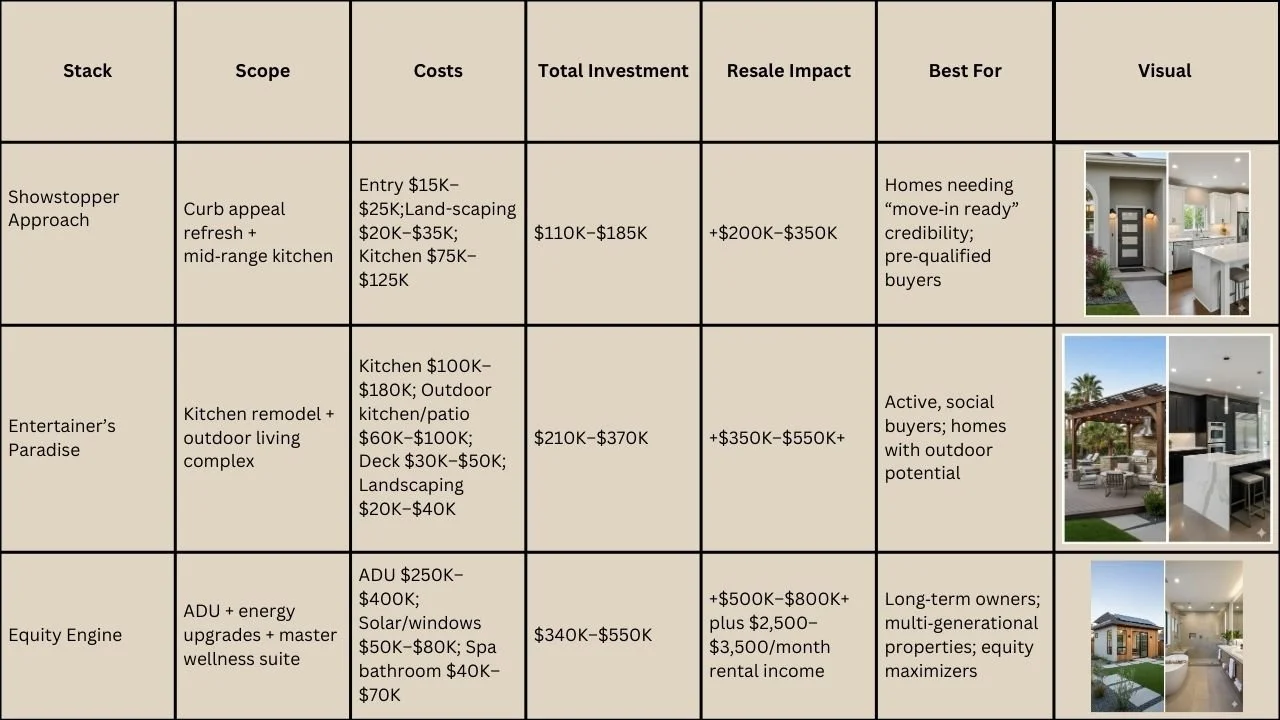
Market Callout
ROI shifts by micro market:
Montecito: Ultra premium, historic; spa bathrooms command higher premiums.
Goleta: Emerging, younger demographic; balanced upgrades resonate.
Carpinteria: Coastal, family focused investments perform best.
2026 Market Reality & Five High-ROI Trends
High demand for ADUs, outdoor living, and wellness spaces. Buyers value energy resilience and intelligent systems. Material costs stabilized.
Kitchen Remodels (50% to 96%, ROI)
Value: $75K remodel typically recovers $60K–$72K at resale.
Design zones: Prep → Cook → Serve → Entertain → Cleanup.
Materials: Locally sourced cabinetry, quartz/marble countertops, handcrafted tile, pro grade appliances.
Bonus: Remote work nooks add hidden buyer appeal.
Why it matters: Kitchens deliver both resale ROI and daily lifestyle upgrades.
2. Outdoor Living (68–82% ROI)
Scope: Patios, decks, outdoor kitchens, fire wise landscaping.
Design essentials: Covered pergola, grill + sink, ambient lighting, fire pit, water features.
Integration impact: Cohesive kitchen + patio + landscape can push ROI to 75–110%.
Why it matters: Coastal buyers pay premiums for seamless indoor-outdoor living.
3. Wellness Upgrades (35–100% ROI)
Spa bathrooms: Soaking tubs, heated floors, steam showers, circadian lighting.
Energy efficiency: Triple glazed windows, insulation, solar, smart glass (67–74% ROI).
Smart homes: Climate control, adaptive lighting, security, energy dashboards.
Why it matters: Code compliance + buyer expectation = mandatory upgrades, wellness is now baseline, not a luxury.
4. Curb Appeal (188–193% ROI)
Fastest wins: Entry doors, garage doors, siding, landscaping.
ROI leaders: Garage door replacement (267.7%), steel entry doors (216.4%).
Fire-wise compliance: Defensible space landscaping doubles as an aesthetic upgrade.
Why it matters: Buyers decide at the curb. Strong first impressions drive confidence and higher offers.
5. Accessory Dwelling Units (ADUs) (60–85% ROI + Rental Income)
Costs: Detached ADU $250K–$400K; conversions $100K–$250K.
Income: $1,800–$3,500/month rental; 5–10 year payback.
Design principles: Architectural harmony, thoughtful site planning, seismic compliance.
Why it matters: ADUs solve housing shortages, add equity, and create multi-generational flexibility.
The 2026 Aesthetic—Cloud Dancer & Timeless Materials
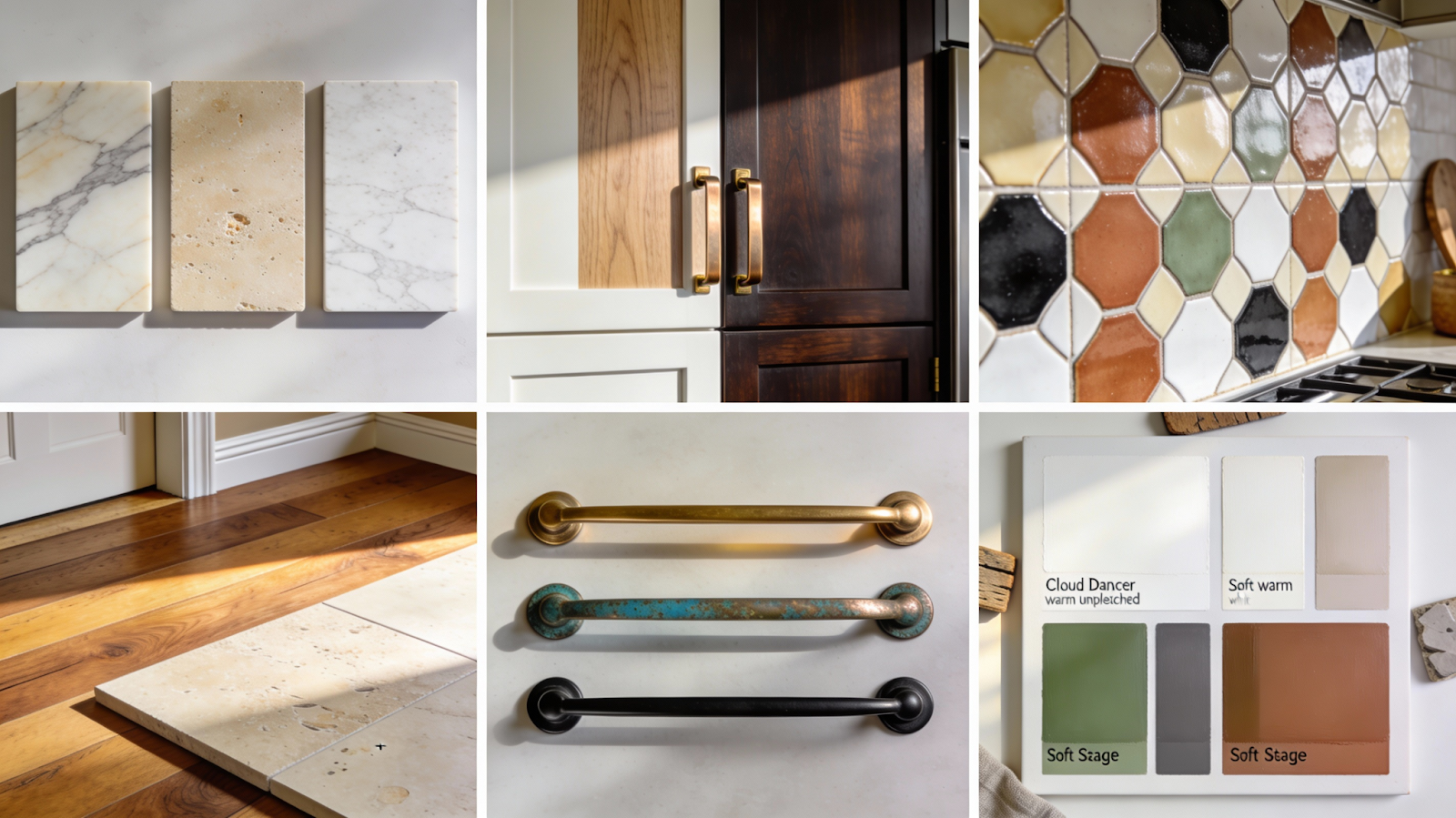
Pantone's 2026 Color of the Year is Cloud Dancer a warm, unbleached white with subtle natural undertones. It's not stark, not yellow, not gray: it's a calming, versatile foundation working across Santa Barbara's architectural diversity.
In a world of relentless color trends, Cloud Dancer signals intentionality, calm, and timelessness. A kitchen painted Cloud Dancer will look elegant in 2026, 2036, and 2046.
Best Applications for Cloud Dancer
1. Exterior Siding
Perfect for Mediterranean, Craftsman, and Coastal homes which adds warmth without heaviness.
2. Interior Walls
Pairs beautifully with natural wood, stone, warm metals, and organic textures.
3. Kitchen & Bathroom Cabinetry
Works with brass, copper, nickel, and blackened steel hardware for a refined, modern look.
4. Ceilings
Amplifies natural light and creates an airy, open feel in coastal spaces.
5. Trim & Millwork
Unifies rooms with a calm, cohesive finish that feels elevated but understated.
Quality Materials That Age Well:
| Category | Timeless | Why It Ages Well | Avoid |
|---|---|---|---|
| Countertops | Marble, limestone, quartz (neutral) | Develops patina; luxury feel; durability | High-gloss epoxy, saturated colors |
| Cabinetry | Solid wood or custom semi-custom | Craftsmanship lasts 30+ years | Thin veneer, trendy finishes |
| Backsplash | Handcrafted tile (zellige, encaustic) | Artisan quality; pattern is timeless | Trendy patterns, bold colors |
| Flooring | Wide-plank hardwood, large-format stone | Natural materials age with character | Trendy laminate, glossy finishes |
| Hardware | Unlacquered brass, weathered copper, blackened steel | Patina deepens over time | Chrome, rose gold, thin plating |
Note: Invest in bones (structure, layout, core materials) that last. Express personality through temporary elements (decor, textiles, lighting).
Resilience & Sustainability—Fire, Energy, Smart Systems
Santa Barbara’s coastal, seismic, and fire prone geography makes resilience a non‑negotiable design pillar in 2026. Three forces shape every high performing home: energy efficiency, fire hardening, and smart systems.
1. Energy is Now Mandatory
Solar and battery backups are no longer "optional upgrades", they are now the baseline building code in California.
The Investment: ~$58k – $107k for a full energy stack.
The Goal: Net zero bills and a home that stays powered during grid outages.
2. Fire-Hardening is Non-Negotiable
If you live in the foothills or near the coast, your home must be built to survive embers.
Must-Haves: Metal or clay roofs, ember resistant vents, and stone decks.
Landscape: You need "Defensible Space" (50–150 ft of cleared, fire-resistant plants).
3. Nature-Driven Design (Biophilic)
In 2026, we don't just decorate with plants; we build with them.
Top Trends: Living walls, raw wood beams, and natural stone (marble/limestone).
The Payoff: Higher resale value and a home that actively lowers your stress levels.
4. "Invisible" Smart Homes
Forget clunky gadgets. The 2026 home is "Ambient", iit thinks for you.
Automation: Lights that mimic the sun, leak detectors that shut off your water, and AI-managed climate control.
The Standard: These are now "baseline" expectations for Santa Barbara buyers.
Why "Design-Build" is Smarter
Santa Barbara’s permits are famously difficult. The old way (separate architect and builder) often leads to delays and budget spikes.
The Win: One team handles everything from the first sketch to the final permit.
The Speed: Cuts a typical 18-month project down to about 10 months.
Why Design-Build Model Wins in 2026
Traditional Design-Bid-Build Problem: Here’s what usually happens:
A designer makes the plans
A contractor starts building
The contractor finds problems the designer didn’t see
Change orders start piling up
The timeline gets longer
The cost keeps going up
The final result doesn’t match what you wanted
This happens because the designer and contractor are not working together, so mistakes show up in the middle of the project.
Design-Build Advantage: With Design‑Build, the architect and contractor work as one team from day one.
This means:
No mid project surprises
Fewer change orders
Faster timelines
Better communication
The finished home matches the original vision
Everything is planned together, so problems are solved before construction starts.
Santa Barbara-Specific Reality & Mistakes to Avoid
Regional Wisdom:
Avoid style clashes: Don’t impose SoHo loft aesthetics on Spanish Colonial homes, it hurts authenticity.
Micro-markets differ: Montecito ≠ , Goleta ≠ , Carpinteria. Each area has unique buyer expectations and property values.
Preserve character: Respecting architectural heritage protects long-term value and community appeal.
Common Mistakes:
Trend-chasing over timeless design, 5-year regrets
Underestimating budget/timeline, 20–40% overruns are common
Skipping fire/water resilience, Penny-wise, pound-foolish in coastal climate
ROI-only thinking, Ignores daily quality-of-life gains
5-Step Action Plan
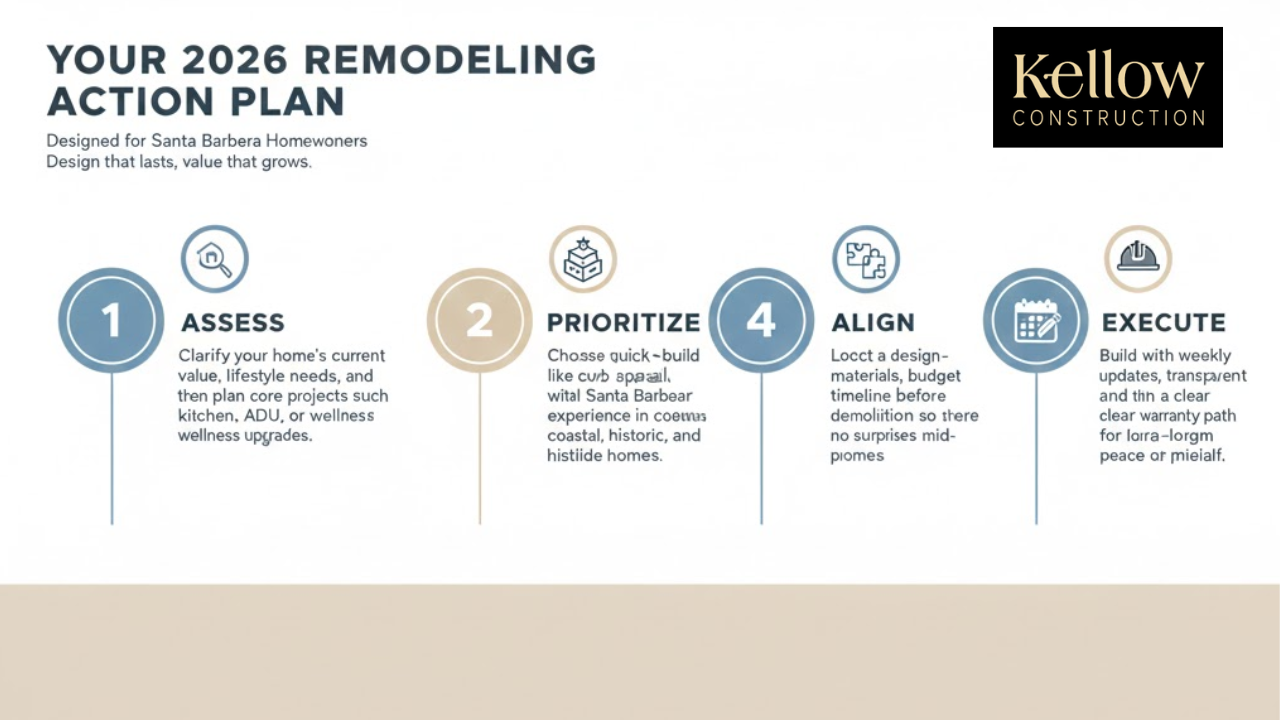
Assess: Evaluate your home’s current value, lifestyle needs, and set a 30% renovation ceiling.
Prioritize: Balance quick wins (curb appeal) with core projects (kitchen, ADU, wellness spaces).
Align: Choose a design-build partner familiar with Santa Barbara’s unique regulations and culture.
Plan: Lock in scope, materials, budget, and timeline before demolition begins.
Execute: Maintain weekly communication, track transparent costs, and secure a clear warranty path.
Conclusion
Santa Barbara remodeling in 2026 blends timeless design with resilience, ensuring comfort, ROI, and heritage preservation. By aligning budgets, lifestyle goals, and design-build expertise, homeowners can achieve spaces that honor coastal character while delivering lasting value, daily joy, and future-proof luxury.
FAQs
Q1: What is the 30% rule in remodeling?
It means investing up to 30% of your home’s value to maximize ROI without over improving.
Q2: Why is design-build recommended in Santa Barbara?
It streamlines permits, reduces delays, and ensures architects and contractors collaborate from day one.
Q3: Which upgrades deliver the highest ROI?
Curb appeal, kitchens, ADUs, and wellness spaces consistently outperform other remodeling investments.
Q4: How do micro-markets affect remodeling choices?
Montecito, Goleta, and Carpinteria have distinct buyer expectations, so upgrades must match local demand.